

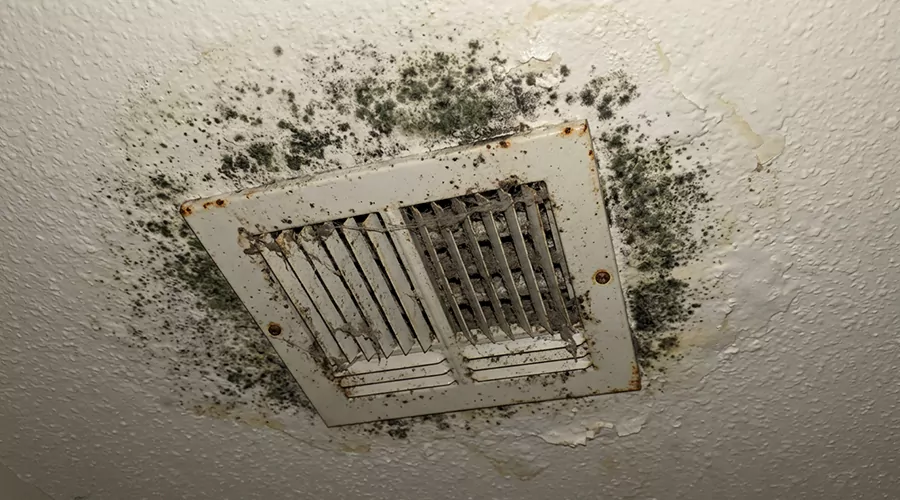
Mold in air ducts develops when moisture remains on duct surfaces long enough for airborne mold spores to grow. Condensation, water leaks and poorly maintained cooling equipment are common sources of moisture. Mold can begin developing on damp materials within 24 to 48 hours under suitable conditions. However, visible dark deposits inside a duct do not automatically confirm mold contamination.
Air duct systems move conditioned air throughout a home. During normal operation, airborne particles can settle on duct surfaces and HVAC components. When those surfaces remain dry, mold growth is less likely. Problems develop when moisture combines with dust or other materials that provide nutrients for mold.
Understanding what causes mold growth helps homeowners identify the source before damage spreads. Cleaning visible contamination without correcting the moisture problem usually provides only temporary results. The condition of the duct material also determines whether cleaning is possible or replacement becomes necessary.
What Are the Main Causes of Mold in Air Ducts?
Mold grows inside ductwork when sufficient moisture is present on surfaces that can support fungal growth. The moisture may come from condensation or water entering through damaged building components. Dust and organic deposits can provide nutrients, while poorly maintained HVAC equipment may allow damp conditions to continue. Our HVAC mold remediation team addresses all of these conditions.
Condensation Inside Air Ducts
Condensation is one of the most common moisture-related problems affecting cooling systems. It develops when warm humid air contacts a surface that is colder than the surrounding air's dew point. If the temperature difference is sufficient, moisture collects on the surface and can remain there when drying conditions are poor.
Ducts running through unconditioned attics are particularly vulnerable when their insulation is damaged or incomplete. Cold supply ducts may come into contact with humid air through gaps around their connections. Repeated condensation can wet nearby insulation and allow mold to develop when suitable nutrients are available.
High Indoor Humidity
High humidity increases the likelihood that moisture will collect on cold HVAC surfaces. Bathrooms and poorly ventilated rooms can introduce additional moisture into the indoor environment. When indoor humidity remains elevated, air conditioning equipment may struggle to control dampness under certain operating conditions.
The Centers for Disease Control and Prevention recommends keeping indoor humidity no higher than 50% to help prevent mold growth. A humidity meter can help homeowners monitor conditions throughout the day. Readings that repeatedly exceed this level indicate that moisture control deserves attention, particularly when condensation is already visible.
Clogged Condensate Drain Lines
Air conditioners remove moisture from indoor air as it passes over the evaporator coil. The resulting water normally collects in a drain pan and exits through a condensate drain line. If the line becomes blocked, water may collect around the cooling equipment instead of draining properly.
Standing water can keep nearby surfaces damp and contribute to contamination when dust or other materials are present. A damaged drain pan may create similar conditions even when the drain line itself is clear. Checking for unusual water accumulation around accessible HVAC equipment can help identify a developing drainage problem.
Water Leaks Around Ductwork
Roof leaks and plumbing problems can introduce water into spaces containing air ducts. If the water reaches duct insulation or enters through an opening, affected materials may remain damp long after the original leak stops. Hidden duct sections are particularly concerning because moisture damage may not be visible from occupied rooms.
Flexible ducts and internally insulated ductwork can absorb or retain moisture in ways that make complete drying difficult. When contamination develops within porous materials, ordinary surface cleaning may not remove it effectively. Locating the original water source is necessary before deciding how to address the affected duct section.
Poorly Sealed Duct Connections
Damaged duct connections can allow humid air from attics or crawlspaces to interact with colder duct surfaces. This may contribute to condensation when temperature conditions are suitable. Return-side leaks can also draw unfiltered air containing particles into the HVAC system.
Air leaks do not automatically create mold because moisture must still be available for growth. However, poorly sealed connections can worsen conditions that support contamination. Maintaining properly connected and insulated ductwork helps reduce unwanted air exchange and condensation.
Dirty Evaporator Coils and Drain Pans
The evaporator coil is designed to become cold during air conditioning operation. Moisture naturally condenses on its surface, and the drain system should remove that water. When dirt accumulates on nearby components or drainage becomes restricted, surfaces may remain wet longer than intended.
A dirty coil does not automatically mean mold is present. However, persistent moisture and accumulated debris can create conditions that support microbial growth. Regular equipment maintenance helps keep the condensate system operating correctly and makes unusual water accumulation easier to detect.
Where Does Mold Usually Develop Inside an HVAC System?
Mold can develop in several parts of an HVAC system when moisture remains present. Areas near cooling equipment deserve particular attention because condensation is a normal part of air conditioning. However, mold may also develop inside damp duct sections or on materials affected by building leaks.
| HVAC Component | Possible Moisture Source | Why Growth May Develop |
|---|---|---|
| Evaporator coil area | Normal cooling condensation | Dirt and persistent dampness |
| Condensate drain pan | Standing water from poor drainage | Moisture remains near accumulated debris |
| Supply air ducts | Condensation on cold surfaces | Damp deposits inside the duct |
| Return air ducts | Water intrusion or humid air leakage | Moisture and settled particles |
| Internal duct insulation | Condensation or building leaks | Porous material retains moisture |
| Air handler cabinet | Drainage problems or water intrusion | Damp surfaces support contamination |
The location of suspected mold can provide useful clues about its cause. Growth near the cooling coil may suggest a drainage or moisture management problem. Contamination concentrated near a roof penetration may instead indicate water entering the duct from outside the HVAC system.
Finding the affected component is therefore an important part of investigating mold in ductwork. Cleaning every duct without identifying where the moisture originates may leave the problem unresolved.
How Can You Tell if There Is Mold Inside Your Air Ducts?
Suspected mold inside air ducts may appear as irregular surface growth or become noticeable through a persistent musty odor. However, these signs cannot confirm mold by themselves because dust and other materials can look similar. A reliable assessment considers both the visible material and evidence of moisture.
A light layer of dark dust inside a duct is not proof of fungal growth. Airborne particles can settle on internal surfaces during normal operation and gradually become visible. The presence of condensation or water damage increases concern because moisture provides the conditions needed for mold development.
Common warning signs include:
- Irregular dark or discolored patches appear on accessible duct surfaces.
- A persistent musty odor occurs when the HVAC system operates.
- Water stains develop near ceiling or wall vents.
- Condensation repeatedly forms around supply openings.
- Insulation around accessible ducts appears damp or damaged.
- Standing water collects in an accessible condensate drain pan.
- Visible growth appears on nearby damp building materials.
- The same suspected growth returns after surface cleaning.
- A recent roof or plumbing leak affected an area containing ducts.
- Unusual deposits appear inside the air handler near a moisture problem.
These symptoms are reasons to investigate rather than proof that mold has spread through the entire HVAC system. An odor may originate from a nearby building material instead of the duct interior. Similarly, dark staining around a vent can result from ordinary airborne dust collecting on cold surfaces.
Mold identification sometimes requires an experienced assessment or laboratory analysis. However, routine air sampling is not always necessary when substantial visible growth and an obvious moisture source are already present.
How Quickly Can Mold Develop in Air Ducts?
Mold can begin developing on damp materials within 24 to 48 hours when environmental conditions support growth. However, the speed of visible contamination depends on moisture availability and the affected material. A wet fiberglass liner can behave differently from a smooth metal duct that dries quickly.
The most important factor is how long the material remains damp. A brief period of condensation that dries completely is different from an ongoing leak that repeatedly saturates insulation. Continuous moisture provides more opportunity for growth and can increase the amount of material requiring attention.
| Condition | Possible Development | Recommended Response |
|---|---|---|
| Brief moisture exposure | Condensation appears on a cold surface | Identify the cause and dry the area |
| Moisture lasting 24 to 48 hours | Mold growth may begin under suitable conditions | Correct the water source promptly |
| Repeated condensation | Damp deposits may support recurring growth | Investigate insulation and humidity |
| Prolonged water damage | Contamination may extend into porous materials | Assess affected components and materials |
| Uncorrected moisture after cleaning | Growth may return | Resolve the original moisture problem |
This progression is not a fixed schedule for every home. Some materials dry quickly, while others retain water in concealed spaces. The 24-to-48-hour period is a prevention guideline rather than a guarantee that mold will appear or become visible within that time.
Can Mold in Air Ducts Affect Indoor Air Quality?
Mold growth inside an HVAC system can contribute to indoor exposure when contaminated material releases spores or fragments into moving air. The amount released depends on the location and condition of the growth. Not every visible deposit enters occupied rooms, but confirmed contamination deserves attention.
Exposure to indoor mold can be associated with allergic reactions and respiratory symptoms in some people. Individuals with asthma or mold allergies may be more sensitive to damp indoor environments. However, symptoms alone cannot establish that air ducts are the source because mold may also grow elsewhere in a building.
The health implications depend on individual susceptibility and the extent of exposure. A small area of surface staining should not automatically be described as a severe health hazard. At the same time, extensive water damage and confirmed contamination should not be ignored.
Can You Check for Mold in Air Ducts Yourself?
Homeowners can perform a limited visual inspection to identify moisture and suspected contamination near accessible HVAC openings. The purpose is to document conditions rather than disturb potentially moldy material. Opening hidden duct sections or brushing suspected growth can release particles and damage internal insulation.
Begin by checking accessible areas for recent water damage or condensation. Photograph any unusual deposits without touching them and note whether the affected area is near a cooling coil or a known leak. A hygrometer can also help identify persistently high indoor humidity.
You can complete the following basic checks:
- Examine accessible vent covers for dampness or irregular staining.
- Inspect nearby ceilings and walls for water damage.
- Measure indoor relative humidity with a hygrometer.
- Check for visible water around safely accessible HVAC drainage areas.
- Photograph suspected contamination without scraping the material.
- Record recent water leaks or repeated condensation problems.
If there is a credible reason to suspect that the HVAC system itself contains mold, stop operating it until the condition has been assessed. Running a contaminated system may distribute material through the building. Avoid taking samples with household brushes or opening equipment compartments that require technical access.
Does Mold Grow More Easily in Metal or Fiberglass Air Ducts?
Mold can develop in both metal and insulated duct systems when moisture and suitable nutrients are available. The main difference is how the materials respond to contamination. Smooth metal surfaces are generally easier to clean, while porous insulation can retain moisture and growth within its structure.
Bare sheet metal does not provide the same porous surface as fiberglass insulation. However, dust and other organic deposits on metal can still support mold when they remain wet. Properly drying the surface and removing contamination may be possible when the duct material is otherwise sound.
Fiberglass duct board and internally lined ducts require more caution. Mold can grow within the spaces between fibers, making complete removal difficult. Wet or moldy internal fiberglass insulation should generally be replaced rather than treated with ordinary cleaning chemicals.
| Duct Material | Moisture Concern | Typical Response to Confirmed Mold |
|---|---|---|
| Bare sheet metal | Wet surface deposits | Cleaning may be possible after correcting moisture |
| Internally lined metal | Moisture trapped in insulation | Affected liner may require replacement |
| Fiberglass duct board | Water retained in porous material | Replacement is generally necessary when moldy |
| Flexible insulated duct | Wet inner liner or surrounding insulation | Affected sections may require replacement |
The material should be identified before cleaning methods are selected. A method suitable for bare metal may damage fiberglass duct board or flexible duct liners. This is why the condition of the duct material matters as much as the visible amount of contamination.
How Much Can Mold-Related Duct Problems Cost in 2026?
The cost of addressing mold-related duct problems depends on how far contamination extends and which materials are affected. Correcting a localized leak is different from replacing moldy insulation or remediating an HVAC system. An accurate estimate requires identifying the affected components rather than pricing the problem by the number of stained vents.
The following are broad U.S. cost benchmarks reported for 2026. They represent different kinds of work and should not be added together automatically.
| Condition | Possible Work | Estimated 2026 Cost |
|---|---|---|
| Minor duct damage causing moisture problems | Duct repair | $200 to $1,000 for many repair projects |
| Confirmed mold in accessible ductwork | Duct mold remediation | $600 to $2,000 for some projects |
| Mold affecting HVAC equipment and ductwork | More extensive remediation | $2,000 to $10,000 |
| Wet or contaminated internal insulation | Remove and replace affected material | Requires an estimate based on the damaged sections |
These estimates depend on accessibility and the amount of material that must be removed. A concealed duct in an attic can require more work than an exposed section in an unfinished basement. Remediation involving multiple HVAC components may also cost more than cleaning a limited area of bare metal.
The larger expense often results from material damage rather than the presence of mold spores alone. Preventing repeated water exposure can reduce the chance of needing extensive replacement work.
When Should You Call a Professional?
Professional evaluation is appropriate when suspected mold appears inside HVAC equipment or on internal duct surfaces. Extensive water damage and contaminated insulation also require careful assessment. The main goal is to confirm the affected materials and identify the moisture source before beginning cleanup or replacement.
A qualified HVAC technician can inspect drainage conditions and determine whether condensation or duct defects are contributing to the problem. A mold remediation specialist may be needed when growth is extensive or involves difficult-to-access materials. The work should address the contamination without distributing debris into occupied rooms.
When substantial growth is confirmed inside bare metal ducts, cleaning may be appropriate after the moisture source is corrected. Internally insulated materials require a different approach because wet or moldy fiberglass cannot be reliably restored through surface cleaning. Replacement of affected material may be necessary.
Before authorizing work, request a clear explanation of the suspected contamination and the affected components. A recommendation based only on ordinary dust or an unexplained air test is not enough to establish the need for extensive duct remediation.
How Can You Prevent Mold From Growing in Air Ducts?
Preventing duct mold depends primarily on keeping HVAC components dry and correcting water problems quickly. Dust control helps reduce available nutrients, but filtration alone cannot prevent growth when moisture remains present. Condensate drainage and duct insulation therefore deserve regular attention.
Maintain Proper Indoor Humidity
Monitor indoor humidity with a hygrometer and aim for approximately 30% to 50% relative humidity when practical. Use bathroom exhaust ventilation during moisture-producing activities and address persistently damp rooms. Air conditioning and dehumidification can help control humidity, but the equipment must operate correctly to remove moisture.
Keep Condensate Drainage Working
Inspect accessible condensate drainage areas during normal HVAC maintenance and watch for standing water or overflow. A properly operating drain system should remove water produced during cooling. Repeated drainage problems require correction because moisture can affect nearby HVAC components and building materials.
Protect Duct Insulation
Check accessible ducts for damaged insulation and signs of condensation. Ducts running through hot attics or humid crawlspaces need suitable insulation and properly sealed connections. Gaps around insulation can expose cold surfaces to humid air, increasing the likelihood of moisture accumulation.
Address Water Leaks Promptly
Repair roof or plumbing leaks as soon as they are identified and dry affected materials promptly. The first 24 to 48 hours after water exposure are particularly important for preventing mold growth. If insulation remains wet or shows signs of contamination, drying the visible surface may not be sufficient.
Conclusion
Mold in air ducts develops when moisture remains on surfaces long enough to support growth. Condensation and water leaks are common causes, while damaged insulation can make cleanup more difficult. Finding and correcting the moisture source is more important than simply removing visible deposits. Significant contamination may require professional assessment. This week, check indoor humidity and look for moisture around accessible HVAC components.